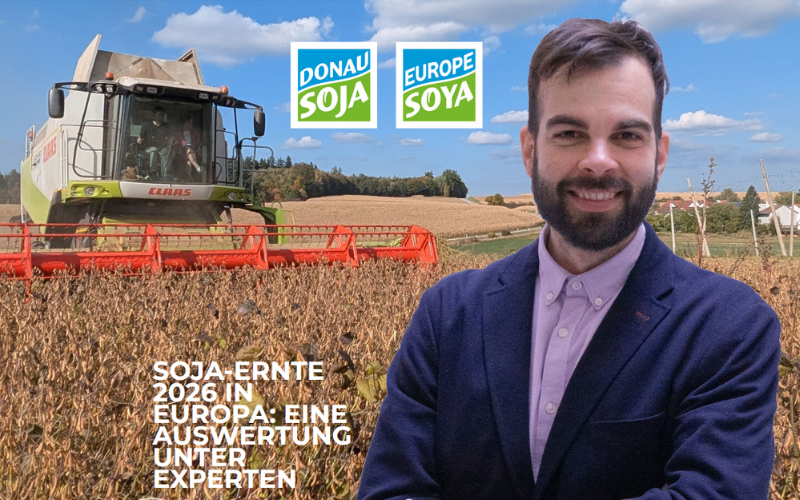
Bertalan Kruppa is a market analyst at Donau Soja. He monitors the development of soybean cultivation in Europe and tracks how harvest volumes, cultivated areas and markets change over the course of the season. His market reports are among the most important points of orientation for farmers, processors and policymakers.
Our expert from sojabohne.com, Lara-Sophie Huppertz, met Mr Kruppa for an interview. She is passionate about the soybean and travels across Germany to help farmers grow and market the “queen of legumes” on their fields, successfully and with high yields.
Both agree that soya is becoming increasingly important in Europe, as the crop is a key source of protein for both animal feed and food.
“Nevertheless,” says Bertalan Kruppa of Donau Soja, “the EU is heavily dependent on soya imports. Self-sufficiency in Europe is currently around 8%. Most imports come from South America and the USA.”
This is where Donau Soja comes in. The organisation supports the entire value chain, from agriculture to processing. Farmers, processors and retailers work together to advocate for a sustainable, secure and European protein supply.
Whether Europe can grow more soya itself will be decided in the field. And can Germany, as sojabohne.com aims, reach 100,000 hectares by 2030? A joint look at this year’s harvest shows where EU countries stand today.
Mr Kruppa, how will this year’s soya harvest turn out in Germany and Austria, and how does the weather affect growing conditions?
In Germany, we have good news. Soya production will rise by around 2% compared with the previous year, to 134,000 tonnes in 2026. The reason is a significantly larger cultivated area, although yields per hectare will be lower.
The situation in Austria is much tighter. For 2026, we expect the soya harvest to fall by around 30%. Yields are at their lowest level in 13 years. The main reason is heat, which has hit large parts of Western Europe. In addition, there is a severe lack of rain. According to GeoSphere Austria, Austria’s precipitation deficit has never been this large since measurements began in 1843.
What soya harvest do you expect in 2026 in the rest of Europe, and how does Germany compare with other European countries?
In most European countries, a decline in harvest volumes is expected in 2026. In the EU-27, the 27 Member States of the European Union, the harvest will fall by around 20%, from 2.97 million tonnes in the previous year to around 2.36 million tonnes. Forecasts for Ukraine, Europe’s largest soya producer, still vary widely. They range from 3.8 to 4.8 million tonnes of harvested soya, which corresponds to a decline of between 2% and 20%. In Serbia, the harvest will be much worse. We expect a drop of around 40% to 100,000–110,000 tonnes. Three years ago, the harvested volume was still 600,000 tonnes.
Germany and Poland look very different. Both countries have significantly expanded soya cultivation in recent years. As a result, Poland is likely to move up to third place among EU soya producers for the first time in 2026, behind Italy and France. Germany remains constant in seventh place.
Which EU countries stand out positively or negatively, and why?
Germany and Poland are the only EU countries that can benefit from the changed situation in 2026. More soya is expected to be harvested there, mainly because the cultivated area is growing. Hungary is different. Soya production there is expected to fall by around 45% compared with the previous year, to 95,000 tonnes. This is due to lower yields per hectare and a smaller cultivated area compared with previous years.
The developments in Germany make me personally very happy. We are actively working to increase the cultivated area. How will this year’s harvest change the self-sufficiency rate and import dependence of the EU-27? And what role does Ukraine play?
Soya self-sufficiency has remained constant at around 8% in recent years. A decline in harvest volumes of around 20% would probably reduce self-sufficiency by 1 to 2 percentage points. How strongly this effect materialises also depends on consumption.
Ukraine plays hardly any role for genetically modified (GM) soya in Europe. For non-GM supply chains, however, it is central to the EU-27. Each year, the EU-27 imports considerable volumes of non-GM soya from Ukraine. Logistical problems and a smaller Ukrainian harvest could therefore noticeably affect the supply of non-GM soya in the next season.
How are prices for non-GM soya developing?
Prices for non-GM soya have risen significantly in recent weeks. In mid-October, non-GM soya cost between 513 and 518 EUR/t in northern Italy and between 525 and 530 EUR/t in southern Germany. This is the highest level in three years.
The price of high-protein non-GM soya in northern Germany has risen particularly sharply. At 670 to 680 EUR/t, it is around 10% above the level of a month ago and around 50% above the level at the beginning of the year. The main reasons are smaller harvests in Ukraine and serious logistical problems. As a result, non-GM soya is becoming much scarcer and more expensive than in previous years.
German farmers have been directly affected in 2026 by external factors such as geopolitical tensions and logistical challenges. What direct effects does this have on the German market?
Energy and fertiliser have become more expensive, and production costs are rising sharply. Soya has an advantage here. The plant fixes nitrogen from the air and therefore needs less nitrogen fertiliser than other cereal crops. In addition, domestic soya prices have risen, which helps soybean farmers with their income.
And what about the non-GM market?
Above all, the war in Ukraine is putting pressure on the German market. In addition, transport costs have risen, and exports via the Black Sea are problematic. Ukraine is an important supplier of non-GM soya to Germany, so these supply chains are under strain. Lower supply and higher import costs are driving prices up. This puts processors and feed manufacturers in a difficult position.
How do you assess the potential for soya cultivation in Europe, particularly in Germany, over the next few years?
Within Europe, Germany and Poland have the greatest potential to expand soya cultivation. Rising temperatures and shifting climate zones make regions attractive for soya that were previously barely suitable. In addition, optimised, early maturing varieties can be grown further north. Growing demand for European non-GM protein also plays an important role in expanding capacity across Europe.
How does the climate affect where soya is grown, and which regions in Germany are best suited?
The record heat this summer has shown how great the risk is. Persistent dryness and summer drought remain the biggest problem for soya cultivation in Germany. Whether such summers will become the new normal, and how the potential can be realised, remains to be seen. A key factor is how well cropping systems and varieties can adapt to more extreme climate conditions.
For Germany, we see great cultivation potential in the coming years, and many developments point to an expansion of the cultivated area. Bavaria and Baden-Württemberg are likely to remain the most important growing regions, but Lower Saxony, North Rhine-Westphalia and Brandenburg can also significantly increase their soya production. Meanwhile, around 65% of Germany’s arable land is in principle suitable for soya cultivation.
Mr Kruppa, thank you very much for the interview and the professional exchange. I look forward to continued good cooperation.
Read the original German version
Download the full article as PDF (German)