EUDR: Donau Soja supports members and partners in implementation
After the recent postponement, the EUDR will apply to large and medium-sized companies from 30 December 2026. Small enterprises will be required to comply from 30 June 2027.
Operators and traders placing the commodities soya, palm oil, rubber, cocoa, coffee, timber products and cattle on the EU market for the first time must demonstrate through a defined due diligence process that their goods were produced deforestation-free (cut-off date 2020) and in accordance with national laws in the country of cultivation, and confirm this via a due diligence statement (DDS). The goods must be traceable back to the field, including geolocation data. Only the first downstream operator must collect and retain the corresponding reference numbers from the primary operator but not check or verify the information. After the first downstream operator, the due diligence stops.
In April 2026, the EU Commission will present a further simplification proposal, but this is not intended to make any fundamental changes to the new legal text.
As a member of the EUDR Expert Group, Donau Soja has the opportunity to discuss open questions directly with the European Commission and to inform our partners first, to be as well-prepared as possible.
However, the following information is not legally binding and may need to be adjusted in the course of the process as new information from the EU Commission becomes available.
Direct support for you
Donau Soja offers advisory services to help you meet the requirements of the EUDR. Contact us at sustainability@donausoja.org
Crop Insights – your EUDR end-to-end software solution by Donau Soja
Crop Insights is a comprehensive end-to-end software designed by Donau Soja to help you to comply with the EUDR along your soya supply chains. It covers all EUDR due diligence steps, from geodata collection and deforestation checks to the submission of Due Diligence Statements to the EU Due Diligence Registry.
For more information please see Crop insights and contact us at info@crop-insights.com!
Background of the regulation
The EU imports millions of tonnes of raw materials every year, for which forests are cleared in other parts of the world. Especially for animal feed, we import about 35 million tonnes of soya every year, mainly from South America, where forests and other valuable ecosystems are converted into agricultural land on an unimaginable scale. According to the FAO, 90% of global deforestation is caused by the expansion of agricultural land. Due to the complexity of the global supply chains of so-called bulk commodities, we often do not know where exactly they come from. However, studies show that the EU is the second-largest cause of global deforestation. This is where the EUDR comes in: The complex supply chains are to be disentangled, so that we can exclude recently deforested areas from EU supply chains and only buy from farmers who do not clear forests.
Cut-off date for deforestation
The cut-off date for deforestation in the EUDR was defined as 31 Dec 2020. This means that areas that have been deforested since 1 Jan 2021 will be excluded from the EU supply chains. The cut-off date is not affected by the postponement of the EUDR.
The EUDR goes even beyond the legislation in the countries of cultivation: Even areas that have been legally deforested in the country of cultivation after 31 Dec Jan 2020 are excluded.
Small and medium-sized enterprises
Medium sized companies must apply the EUDR from 30 December 2026, only small businesses must apply the EUDR six months later – from 30 Jun 2027.
SME traders may only make relevant products available on the market if they document information on buyers and sellers, including reference numbers of the former DDS, and store them for five years. If a DDS already exists for a relevant product, SMEs do not have to complete the whole due diligence process but only have to pass on the reference numbers of the existing DDS.
A new category of “small and micro primary producers” has been introduced. These actors are based in a low-risk country and grow the products themselves and are only required to submit a one-off, simplified declaration. The simplified DDS can contain the address of the fields instead of geodata, harvest quantities can be based on estimates, and it only needs to be renewed in the case of fundamental changes.
In EU Member States where all the information required for the DDS is available in a system or database, micro or small enterprises are not required to submit a one-off simplified declaration; instead, Member States must make this information available for each enterprise in the information system. After the company has been assigned a declaration number, it may then place the products in question on the market or export them.
Small companies is defined as not exceeding more than one of the following three criteria (based on EU Directive 2013/34/EU – Article 3):
- Balance sheet total: EUR 7,500,000 / Net turnover: EUR 15,000,000 / Average number of employees: 50
Medium-sized enterprises do not exceed more than one of the following three criteria:
- Balance sheet total: EUR 25,000,000 / Net turnover: EUR 50,000,000 / Average number of employees: 250
Checks and penalties
The competent authority of each EU member state is responsible for checking the respective imports and exports to and from the country. For imports from low-risk countries, 1% of relevant goods and operators are to be checked each year, for standard-risk countries 3% and for high risk countries 9% of operators and goods.
Penalties can be up to 4% of the company’s turnover in the EU. In addition, companies can be temporarily excluded from public tenders or banned from placing relevant products on the market.
Page Navigation
How to prepare
When getting prepared for the EUDR you have to consider the following aspects:
1) Is your company small, medium, or non-SME?
2) Analyse your supply chain
Do you purchase relevant products? (see Annex 1 or “Which soya is covered by EUDR” below)
If so
- What information about these products do you have already?
- What information is missing? (Gap analysis see Article 9 EUDR or “Information collection” below)
- Where do I get the products from? (suppliers, countries..)
- What are the risks?
- What do I do or can I do to mitigate the risks?
3) Establish a timetable for the changes needed in your company.
This could include:
- Action plans towards EUDR compliance
- Involving suppliers – What do my suppliers know/do?
- Prepare IT system and look into API testing
- Analyse what tools and certifications are available and fit for your purpose
Donau Soja offers advisory services to help you meet the requirements of the EUDR. Contact us at sustainability@donausoja.org
Helpful links for further information
EUDR Text available in all EU languages:
Information on the Due Diligence Registry:
Information of European Commission on EUDR Implementation incl. FAQs:
Information on EUDR Implementation in German:
FAQs in German:
Country Risk benchmark:
Information on TRACES = EU platform for imports of animals & food products, incl. EORI
Free Online tool for Geocoordinates:
The Role of EU Farmers and Companies
The first due diligence process and the completion of the first DDS always lie with the first market participant located in the EU who makes the goods available on the market. Companies outside the EU can only issue a DDS that is not legally binding, hence the first company in the EU must always upload the first legally binding DDS.
Soya farmers in the EU are the first operators of the soya and thus responsible for ensuring the legality and deforestation-free production of the soya as well as completing the DDS. However, a couple of simplifications were introduced:
- Farmerscan authorise the next level of the supply chain to fill in the DDS (e.g., the storage facility or cooperative)
- A new category of “small and micro primary producers” has been introduced. These actors are only required to submit a one-off, simplified declaration, e.g. the use of postal addresses instead of geolocation for the plots of land.
- In EU Member States where all the information required for the DDS is available in a system or database, farmers are not required to submit a one-off simplified declaration; instead, Member States must make this information available for each farmer in the information system. After the farmer has been assigned a declaration number, it may then place the products in question on the market or export them.
For EU farmers, the EUDR requirements may vary slightly between member states, but the overall aim is consistent across the EU. For example, the German Ministry of Agriculture (BMEL) has outlined specific guidelines for German farmers:
What specific obligations do agricultural businesses in Germany have?
The following applies to primary producers in Germany: They do not have to introduce a due diligence system on the farm but must record their production areas using geolocalisation coordinates.
- All information that may be required in the event of an inspection under the Regulation is usually available on the farm, for example in the form of a purchase or lease agreement. In case of doubt, the cultivated area as recorded in the land register, for example, can serve as proof of compliance with the regulation.
Which Soya is covered by the EUDR
Annex I of the EUDR defines the products to which the due diligence obligations apply (see box below).
For these products, the due diligence process must be completed and the DDS uploaded before they are placed on the EU market or exported.
The due diligence obligation for soya in animal feed, for example, ends when the soya has been consumed (with the exception of cattle, as cattle itself is listed in Annex I of the EUDR).
What does soya mean here?
Annex I of the Deforestation Regulation defines which products are covered and can be compared using the customs numbers:
- 1201 Soya beans, whether or not broken
- 1208 10 Soya bean flour and meal
- 1507 Soya bean oil and its fractions, whether or not refined, but not chemically modified
- 2304 Oilcake and other solid residues resulting from the extraction of soya bean oil, whether or not ground or in the form of pellets, resulting from the extraction of soya-bean oil
The Due Diligence Process
First distributors on the EU market must use a three-stage due diligence process to ensure that their relevant supply chains comply with the regulation and confirm this via the upload of a DDS.
When is a DDS required?
Following the latest amendment, a DDS is only required for the first import/sale of a relevant product on the EU market or for the first export of domestically grown products. The first downstream operator must retain the reference number but not check or verify the information. After that, there are no further due diligence obligations.
Most EU and European countries are classified as low risk. This leads to a so-called simplified due diligence process, which only consists of collecting information and does not require any risk assessment or mitigation. This means less bureaucracy for European soya.
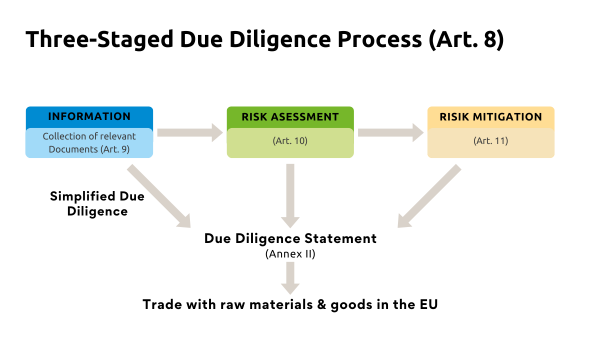
Graphic 1: Visualisation of three-staged EUDR due diligence process before relevant products are allowed to be sold on the EU market.
Information Collection
Primary Operators must collect, verify and store following information for five years according to the EUDR (Article 9 Information requirements):
Trade name and type
Quantity
Country / region of cultivation
Geolocation of all plots of land where the commodity was grown
Production- / harvest-date
Proof of legal compliance
Proof of deforestation-free cultivation
Name, address and e-mail address of company from whom and to whom the relevant products have been supplied (seller and customer)
Due Diligence Statement (DDS)
Before placing relevant goods on the EU market for the first time or exporting them, a DDS must be uploaded to the EUDR Information System in TRACES. Only then the goods may be traded.
Information that must be included in the DDS (Annex II):
Name and address of the market participant (including EORI number if applicable)
If applicable: reference numbers of existing DDS’s (e.g. when processing soya beans into oil)
Trade name and type
Quantity
Country/ region of cultivation
Geolocation data of all plots of land where the relevant commodity was grown
Confirmation that the due diligence process has been applied and that the product is low risk
When is a DDS required?
Whenever affected soya products are made available, traders must ensure that the relevant information is passed on as part of the DDS.
When processing relevant products, e.g. soya beans into soya oil, a new DDS must be created with the information from all previous DDS’s.
The European Commission has yet to define when this should be done for ongoing processes.
The Role of Donau Soja
Certified goods do not automatically guarantee compliance with the EUDR. Article 11 – Risk Mitigation and the official EUDR Guidanc – mention on-site audits and third-party certification as an option for risk minimisation, but they do not relieve from the due diligence process or liability.
With Donau Soja / Europe Soya certified soya, it is ensured that the soya is deforestation- and conversion-free, with the cut-off date 2008, and produced in accordance with national legislation. Thus, the deforestation- and conversion free requirements of Donau Soja / Europe Soya are stricter than the EUDR.
Additionally, with Crop Insights – software designed by Donau Soja to help you to comply with the EUDR along your supply chains – operators can cover important EUDR due diligence steps, from geodata collection and deforestation checks to the submission of Due Diligence Statements to the EU Due Diligence Registry.
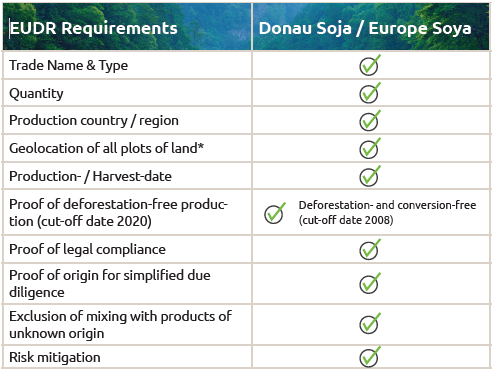
Together, Donau Soja / Europe Soya and Crop Insights can help you with EUDR information requirements and the requirements for your Due Diiligence Statement (DDS)
Information Collection
*If required
Table 1: EUDR Information requirements (Article 9) .
Due Diligence Statement (DDS)
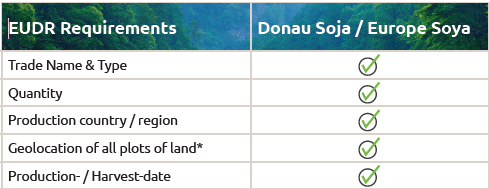
*If required
Table 2: Requirements of the EUDR Due Diligence Declaration and where Donau Soja / Europe Soya can help.
Geolocalisation data
The geo-coordinates of all cultivation areas must be collected as part of the information collection and DDS, regardless of whether the product originates from low, standard or high-risk countries.
Additional requirements for farmers will mainly consist of collecting and sharing the geolocation data of all fields where soya has been grown.
The geo-coordinates of all cultivation areas must be collected as part of the information collection and DDS, regardless of whether the product originates from low, standard or high-risk countries.
Additional requirements for farmers will mainly consist of collecting and sharing the geolocation data of all fields where soya has been grown.
An easy way to find out the geo-coordinates is to use digital online map services, such as Google Maps or similar programmes, and click on the relevant location. Attention: When using Google Maps coordinates, the order of longitude and latitude must be reversed because the EUDR system uses the opposite sequence compared to Google.
By simply clicking on the corresponding location, a marker is set (see red marker in graphic 2 on the right) and information about the location including the geo-data is displayed (see highlighted figures in yellow in graphic 2 on the right).
It will probably also be possible to enter all of a farmer’s areas, regardless of whether soya was grown there in the respective year (so-called “Declaration in Excess”). This simplifies the process in subsequent years if soya is grown on a different section of land of the farmer.
Geodata requirements
- Field area under four hectares: one geo-point is sufficient (this simplifies EUDR compliance for small farms )
- More than four hectares: polygon information required (one geo-point for each corner of the plot)
- If soya is grown on multiple fields: all plots of lands must be specified, depending on their size either with one geo-data point (<4 hectares) or polygon (>4 hectares)
- Accuracy: six decimal places must be provided for each geo-point
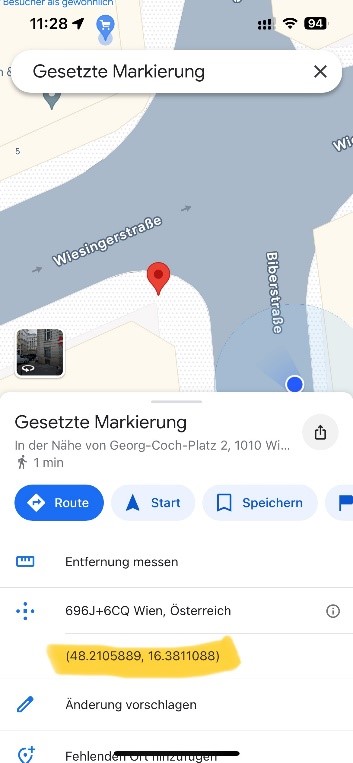
Graphic 2: Illustration of geo-coordinates using Google Maps.
What is missing?
1. Scope
In terms of content, one of the biggest shortcomings is that land conversion of other sensitive ecosystems is not covered by the regulation. The EUDR already stipulates that there should be reviews and proposals for expansion. The first reviews in 2025 and 2026 include the topics of including “other wooded lands and ecosystems”, other raw materials such as maize, and the inclusion of financial institutions – were moved to 2030. After five years, the impact on trade, especially on small farmers, and possible trade facilitation measures will be reviewed. A thorough impact assessment would have been needed before the regulation came into force..
2. Sustainable Soya
Sustainable soya cultivation must take into account further issues such as the reduction of CO2 emissions, pesticide and fertiliser reduction, water management, soil management, protection of biodiversity, GM-free, varied crop rotations (no monocultures) and compliance with human and labour rights. Compliance with the EU Deforestation Regulation alone does not ensure sustainable supply chains. Strict cultivation standards that take these issues into account therefore remain an important tool for making EU supply chains more sustainable.
For more information contact us at sustainability@donausoja.org.
Why should landscapes other than forests be protected?
In Brazil, for example, most land conversion for new agricultural land takes place in the Cerrado, the world’s most biodiverse savannah. The Cerrado is also extremely important for the water cycle in South America and interacts closely with the neighbouring Amazon rainforest. However, the largest parts of the Cerrado do not fall under the forest definition of the EUDR, hence are not protected under the regulation. Deforestation rates in the Amazon have fallen significantly under the new Brazilian government since the beginning of 2023 – but record areas are still being converted to agriculturar land in the Cerrado.

For more information contact us at sustainability@donausoja.org.